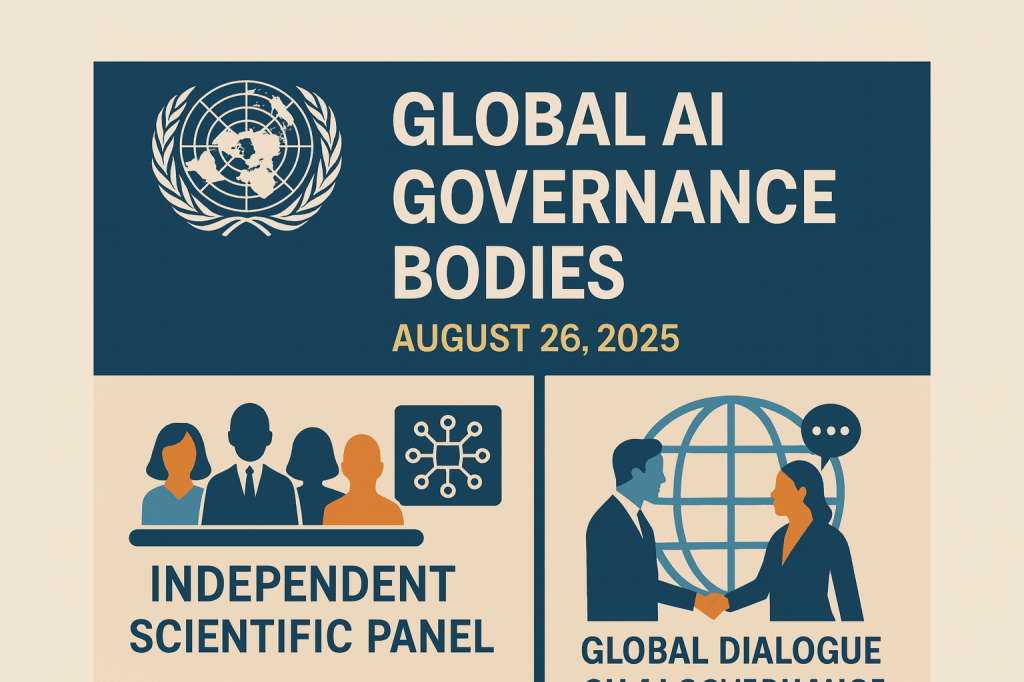
On August 26, 2025, the United Nations General Assembly adopted a new resolution (A/RES/79/118) that formally established two AI governance mechanisms to ensure that AI development and deployment is in line with human rights and democratic values. This is a major milestone in global AI governance that was co-sponsored by 123 countries and adopted by full consensus.
- Independent International Scientific Panel on AI – The panel will be composed of 40 multidisciplinary experts including science, ethics, law, economics, and civil society. It will be responsible for providing evidence-based assessments of AI risks and benefits. It will also produce annual reports to inform UN member states and help align national policies with global standards.
- Global Dialogue on AI Governance – This is a multi-stakeholder platform designed to foster international cooperation on AI governance. It will include governments, academia, industry, and civil society, and will serve as a space for sharing best practices, developing ethical norms, and promoting inclusive global frameworks.
These are critical times in AI governance. We are witnessing growing tensions between public and private sector interests, conflicts across local and federal jurisdictions, and deep disagreements among leading nations on what AI regulation should look like. Against this fragmented backdrop, the UN’s decision to establish formal global mechanisms feels both timely and necessary. These mechanisms demonstrate a shift from voluntary principles to structured, multilateral accountability and offer hope for coordinated, transparent, and inclusive policymaking that could help steer the AI ecosystem toward shared ethical foundations.
Whether these new institutions can keep pace with the speed of AI development and earn the trust of both governments and the public remains an open question. One of the biggest potential challenges I see is asymmetry of power and resources. Smaller countries and local governments are often left out of global standards-setting, while tech giants move faster than regulators. The UN’s model could be a bridge but only if it is resourced, independent, and truly representative.
Another issue that jumps out to me is the complete silence from the US. As of early September 2025, there has not been any formal public statement issued by U.S. officials in response to this global development. While several international actors have welcomed this resolution and the US has previously championed international cooperation on AI, this latest step appears to have gone unacknowledged by federal agencies or diplomats, at least publicly. This could represent a focus on domestic AI policy rather than multilateral institutions.


 AI Policies for a Safer, Smarter World.