
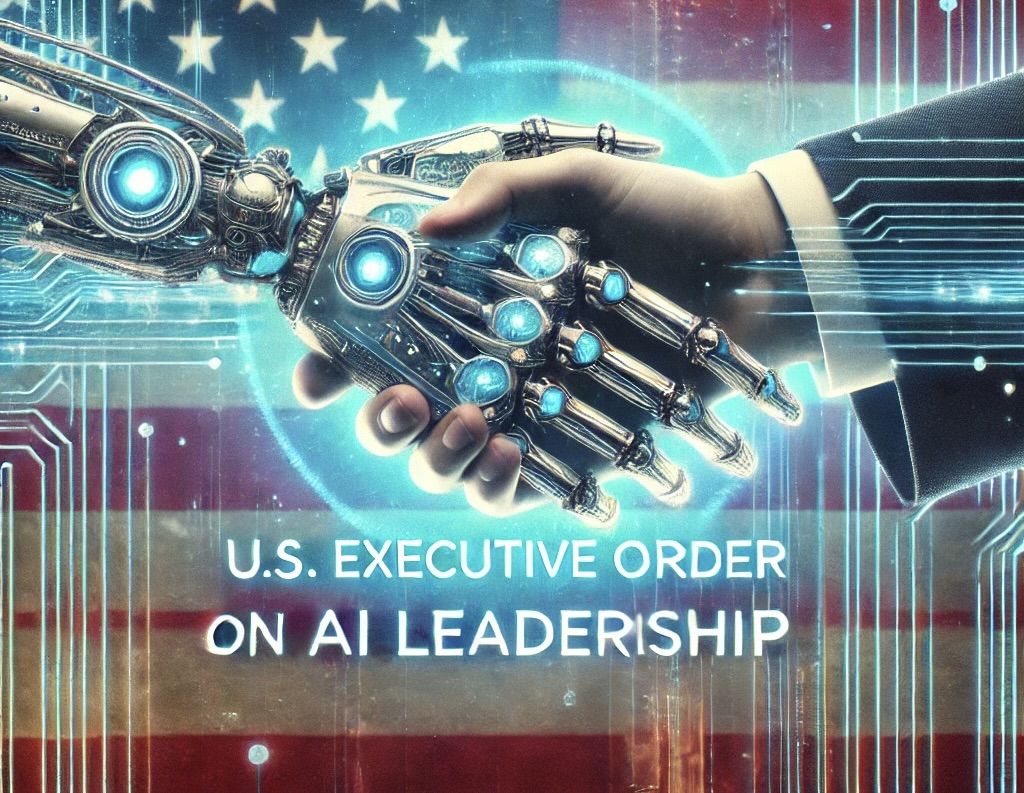
On January 23, 2025, President Trump signed an executive order titled “Removing Barriers to American Leadership in Artificial Intelligence.” Just two days prior to the new EO, the president had announced an ambitious $500 billion Stargate Initiative. This initiative is a collaboration between OpenAI, SoftBank, and Oracle to bolster America’s AI infrastructure through massive investments in data centers and computing power.
The new EO is a significant departure from the Biden administration’s regulatory approach to AI. This EO, coupled with the Stargate project, signals a dramatic shift in the U.S. AI policy. It aims to solidify USA’s dominance in AI by removing regulatory obstacles and refocusing national priorities on innovation, economic competitiveness, and national security.
Key Provisions of the new Executive Order
- Revocation of Biden’s AI Policies
The order immediately rescinds President Biden’s 2023 Executive Order on Safe, Secure, and Trustworthy Artificial Intelligence, which focused on AI safety, privacy, and anti-discrimination measures. It also directs federal agencies to suspend or revise policies, regulations, and guidance issued under Biden’s order that conflict with Trump’s new priorities. - Focus on Innovation and “Ideological Neutrality”
The order emphasizes developing AI systems “free from ideological bias or engineered social agendas”. It calls for eliminating “burdensome” requirements that were seen as stifling private-sector innovation. Critics argue that this targets diversity, equity, and inclusion (DEI) initiatives. - New AI Action Plan
A 180-day deadline is set for the creation of an AI Action Plan led by White House officials, including the newly appointed Special Advisor for AI and Crypto, David Sacks. The plan aims to solidify U.S. dominance in AI through economic competitiveness and national security. - Federal AI Governance Overhaul
The Office of Management and Budget (OMB) must revise Biden-era memoranda on federal AI governance and procurement by March 24, 2025, to align with the new deregulatory stance.
Contrasting Trump and Biden AI Policies
The stark contrast between Biden’s “Safe, Secure, and Trustworthy Development and Use of Artificial Intelligence” and Trump’s “Removing Barriers to American Leadership in Artificial Intelligence” executive orders is evident in their titles alone, reflecting fundamentally different priorities and approaches to AI policy.
The Biden order had directed agencies to study AI’s impact on jobs, create anti-bias guidelines, and ensure federal contractors used AI responsibly. Trump’s repeal of these measures reduces pressure on companies to address AI-related labor or bias concerns. Free-market advocates praised the order for eliminating “red tape” and aligning AI development with economic growth.
The Biden administration’s policies were aimed to align the U.S. AI policies with international standards to ensure global competitiveness and cooperation. The new policies are focused on sustaining and enhancing America’s global AI dominance, with less emphasis on international collaboration.
Federal Agencies must now revise AI procurement rules and governance frameworks, potentially easing compliance requirements for contractors.The new order frames AI dominance as critical to countering adversaries like China, emphasizing technological leadership over collaborative governance.
Looking Ahead
The Trump administration’s AI strategy hinges on rapid execution of its 180-day action plan and revisions to federal AI policies. While the order’s immediate impact is limited, its long-term effects will depend on how agencies balance innovation incentives with public accountability.
On the global front, the EU and China are taking a more regulatory approach to AI. If the U.S. moves toward deregulation while other nations enforce tighter controls, it may create international conflicts over AI safety standards.
The coming months will reveal more as agencies respond to the order and AI regulations evolve. One thing is clear: 2025 is shaping up to be a pivotal year for AI governance in the United States.


 AI Policies for a Safer, Smarter World.