
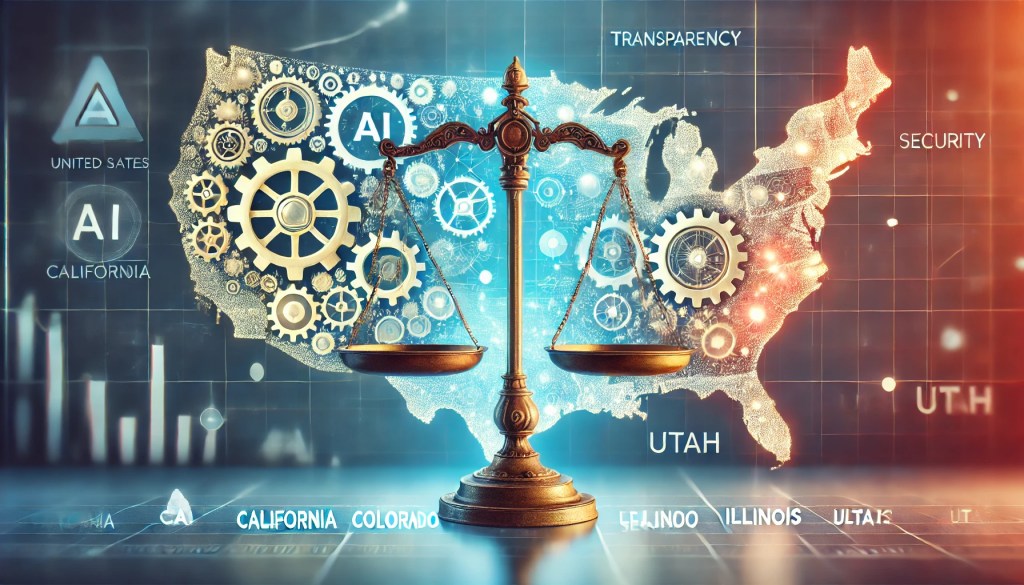
The rapid adoption of AI has introduced complex ethical, legal, and societal challenges. While federal legislation on AI is still taking shape, state governments have stepped up with regulations tailored to address local needs and emerging risks. These initiatives not only set important precedents for ethical AI practices but also influence broader national and global policies.
Key State-Level AI Regulations
- Transparency Laws: California (California AI Transparency Act – SB 942), Illinois (Artificial Intelligence Video Interview Act), Maryland, and Florida states require businesses to disclose when and how AI is used. These measures promote trust and accountability by ensuring individuals understand AI’s role in decisions that affect them.
- Research and Study Obligations: At least 10 states, including Alabama, California, Colorado, and Washington require government agencies to conduct research on AI’s societal impacts. These efforts aim to guide future policy decisions with data-driven insights.
- Deepfake Regulation: Many states (CA AB 2355, CA AB 2839) have implemented laws to regulate deepfake technologies usage. These measures are designed to combat misinformation and protect individual rights, especially in sensitive areas like elections and explicit content.
- Civil Liberties Protections: Several states have enacted restrictions on law enforcement’s use of AI tools such as facial recognition. These laws address concerns about privacy, surveillance, and potential biases in AI-assisted decision-making.
- Task Forces and Advisory Councils: Task forces and advisory councils in many states are actively studying AI’s risks and opportunities. These groups play a critical role in shaping state policies by identifying best practices and areas of concern.
State Level AI Legislatures List
National Conference of State Legislatures provides a list of state level AI legislatures by state and status.
This image (sourced from BCLP Law) provides detailed state-by-state AI legislation information as of June 2024.

Challenges and Opportunities
State-level AI governance comes with both challenges and opportunities. One major challenge is regulatory inconsistency, where different state laws make it hard for businesses operating nationwide to comply. Smaller states often lack the resources, expertise, or funding to create and enforce strong AI policies. Striking a balance between encouraging innovation and regulating AI is also tricky.
These challenges also bring opportunities. Well-crafted state policies can help shape unified federal standards for AI governance. States can also create localized solutions to address specific concerns.
The Path Forward
Under a Trump administration, state AI regulations could grow or stall depending on federal priorities. Trump’s potential focus on economic growth may result in deregulation and minimal federal oversight of AI. This might push states to step in and set their own rules. States with strong regulatory traditions (like California, Colorado, and New York) are likely to lead in AI governance. States favoring less regulation may prioritize innovation. These diverse policy experiments could make compliance harder for nationwide businesses.
As federal policies take shape, the relationship between state and federal initiatives will determine the future of AI governance. Will the federal government unify these efforts, or will states remain the primary drivers?.


 AI Policies for a Safer, Smarter World.