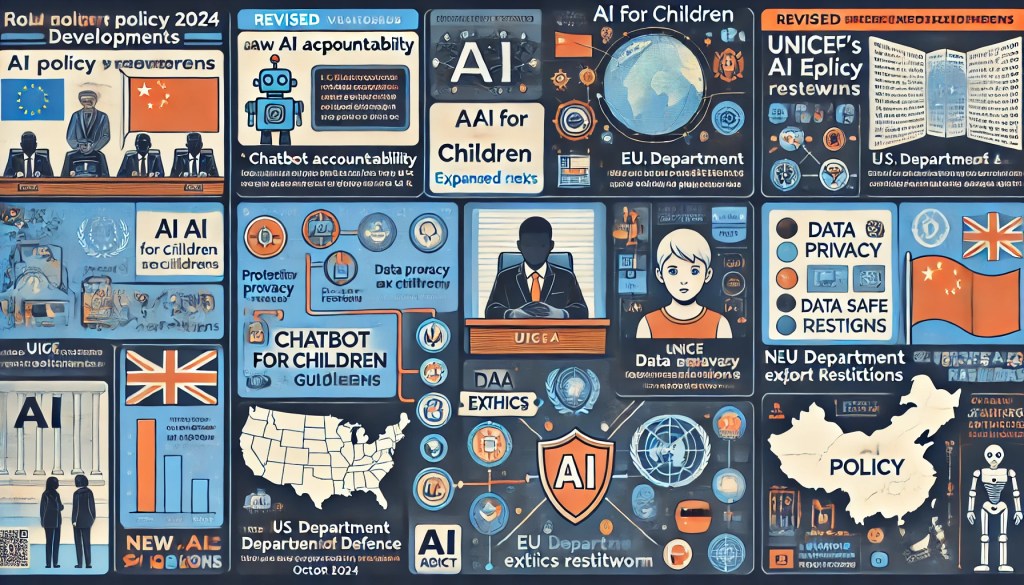
October was an action-packed month in AI, both nationally and globally. There were substantial investments, regulatory updates, ethical frameworks, and new initiatives. Here’s a comprehensive roundup of top developments, why they matter, and where to learn more.
- OpenAI’s Record-Breaking $6.6 Billion Funding Round
Description: OpenAI secured $6.6 billion in funding, the largest ever for an AI company. Major investors included Microsoft and Nvidia. This funding confirms investors’ strong confidence in OpenAI’s potential to shape the future of AI. The funds will support (Artificial General Intelligence) AGI research and commercial expansion.
Why It Matters: The massive funding signals deep interest in Frontier model companies and AI startups. This level of support not only strengthens OpenAI’s capacity to tackle ambitious AI challenges, but motivates competitors to quicken their pace in developing AGI and other transformative technologies.
Learn More: [TechCrunch], [The Verge] - California AI Safety Bill Veto (SB 1047)
Description: California Governor Gavin Newsom vetoed the SB 147 AI safety bill, which would have introduced state-specific AI safety regulations. Newsom’s decision was influenced by concerns that such stringent regulations might hinder innovation. Though the bill was vetoed in late September, the discussions continued well into October. I have covered details about this bill in my earlier blog post – CA SB 1047 and AI Regulation.
Why It Matters: This veto highlights the ongoing debate about whether AI regulations should be managed locally, federally, or globally. It highlights the importance of balancing regulations, innovations, and economic interests.
Learn More: [The Official Veto Message] [TechCrunch] - White House National Security Memo on AI
Description: The White House issued a national security memo that prioritizes AI leadership and security. It highlights Frontier models as critical to the country’s technological edge. The document also urged the U.S. to collaborate with its allies and keep an eye on AI progress by global competitors like China.
Why It Matters: U.S. has shown its competitive stance on AI by making AI leadership a national security goal. This aligns with the Department of Defense’s recent focus on ethical AI for defense. This focus could speed up innovation but also lead to more careful review of AI development and partnerships.
Learn More: [TheWhiteHouse][Breaking Defense] - China’s New AI Export Licensing Rules
Description: China introduced new rules for exporting dual-use items, including certain artificial intelligence (AI) technologies. Tech companies are now required to get government licenses before exporting certain AI models and tools. China claims this is to protect “national security” and “public interest.” However, critics believe it is also a strategic move in the global AI competition.
Why It Matters: These rules exemplify the geopolitical tensions around AI. China’s move may prompt similar responses from other tech-leading nations and impact global cooperation.
Learn More: [ChinaBriefing] - Global Media and Information Literacy Week – UNESCO’s AI Literacy Initiative
Description: UNESCO’s AI literacy initiative was highlighted during the Global Media and Information Literacy Week. This initiative aims to educate citizens, especially in developing countries, on AI concepts, ethical implications, and potential career paths in AI.
Why It Matters: Enhancing public understanding of AI is critical as AI systems permeate more aspects of daily life. This initiative underscores the importance of a globally informed and prepared citizenry that can engage with AI in knowledgeable and ethical ways.
Learn More: [UNESCO][TheSource] - Big Tech’s Shift to Nuclear Power for AI Infrastructure
Description: Amazon, Microsoft, and Google announced nuclear energy initiatives to power data centers sustainably. Amazon is working with X-Energy to develop small modular reactors, while Google signed a power purchase agreement with Kairos Power. Microsoft aims to revive a unit at Three Mile Island through Constellation Energy.
Why It Matters: As AI’s energy demands increase, nuclear power offers a viable path for sustainable expansion, reducing AI’s environmental impact.
Learn More: [Observer] - Nobel Prizes Awarded to AI-Driven Research in Chemistry and Physics
Description: AI-powered discoveries earned Nobel Prizes in both physics and chemistry this month. These awards were granted for research in neural networks and protein structure prediction.
Why It Matters: This recognition underscores AI’s role as a scientific collaborator. It foreshadows an era where AI may drive discoveries across multiple disciplines.
Learn More: [NobelPrize][PhysicsApplied] - Generative AI Adoption Surges in the U.S.
Description: A new report from the St. Louis Fed showed that generative AI adoption among U.S. adults is faster than the adoption of PCs or the internet. 40% of Americans are now using generative AI. It is becoming popular among all age groups and backgrounds, across many domains from customer service and coding to personal wellness and home improvements.
Why It Matters: The public’s willingness to integrate AI into daily routines reflects a shift in AI’s societal role. Such rapid growth necessitates advancements in infrastructure, user education, and ethical oversight to ensure responsible AI use.
Learn More: [St. Louis Fed – published in Sept 2024, usage data from August 2024] - Anthropic Introduces Computer Usage for Claude AI
Description: In late October, Anthropic introduced a new feature for its Claude 3.5 Sonnet model. The model can now interact with computers in a human-like manner (moving and clicking cursor, typing) through a “Computer Use” API. This feature lets developers automate complex tasks. Though early tests look promising, the system still has limits and will need more improvements before it’s ready for regular use.
Why It Matters: This development signifies progress towards creating autonomous agents that can execute tasks directly on behalf of users. Such a capability also introduces critical questions regarding AI agency, security, and ethical use.
Learn More: [Anthropic][TheRegister]


 AI Policies for a Safer, Smarter World.